Showing posts with label Joe Fargis. Show all posts

Friday, March 30, 2012

Bernie Traurig Clinic Report Part One: "Don't Be Afraid to Get Effective in the Tack!"

Like many equestrians, I'm am a learning junkie.  I possess books and DVDs galore, numerous magazine subscriptions, and a plethora of live and video-on-demand subscriptions.  One of my go-to subscriptions is EquestrianCoach.com, an online compilation of equestrian educational videos for the jumping disciplines.  The videos are presented by Bernie Traurig, the site's founder, and other leading lights from the industry, such as Will Simpson, Gina Miles, Missy Clark, Debbie McDonald, and Denny Emerson (to name only a few).  Bernie has reached the top of the sport in Hunters, Show Jumping, and Dressage, and as junior he took top honors in both the AHSA (now USEF) and the ASPCA Maclay finals.

Bernie's detailed descriptions make the information on the videos easily understandable for novice riders and detailed enough for more advanced riders as well. The use of tools such as slow motion, still photos, voice-overs and graphics make these videos as understandable as a football game covered by John Madden and his telestrator.  Think of X's and O's diagrammed out equestrian style -- an absolute epiphany when describing how to ride a bending line!

Yep, I'm a fan, so when I had the opportunity to audit his clinic at USHJA Board of Directors member Mary Babick's beautiful Knightsbridge Farm in Atlantic Highlands, NJ, you can bet I was jumping on that opportunity!  Note -- Mary and Knightsbridge recently hosted Joe Fargis as well (my reports can be accessed here and here).  I'm thinking Mary needs to start marketing these clinics as "The Legends at Knightsbridge Clinic Series." Just saying, Mary. ;)

Bernie started each session by bringing each rider forward so he could look at their tack, examine their bits, and assess their position in the three point and two point seats.  He made adjustments where necessary, tweaking positions, adjusting cavessons (no buckles on the jawbone, please!) and evangelizing about the necessity of a deep heel and long calf for effective leg position and communication. Bernie punctuated this point by telling one rider she had daylight between her horse's side and her calf;  he then placed his fingers between the rider's leg and the horse and asked her to "mold her lower legs" to his fingers. He suggested starting each ride in the two point at a walk for as many minutes as you can without losing position (grab mane so you don't use the horse's mouth for balance) and at one point hopped up on a riser (using Mary as his assistant!) to demonstrate calf and ankle stretches he does on a daily basis.

I learned so much just from this intro portion of the two sessions I watched.  Bernie shared so many of his thoughts on details such as form, correctly fitting tack, and proper bitting ("Your horse will tell you if he loves it.  If he's not happy, change!")  One horse in the first session, described as strong by his rider, went through three bit changes in during the ride: He started out in a corkscrew snaffle, made a change to a twisted D ring, then downgraded again to a rubber D ring.  The horse went from going in a rushed, tense and inverted manner to moving out in a much happier, relaxed and controllable fashion.

One point Bernie mentioned was the correlation between lack of heel depth and stronger bits.  He spoke of how, in the downward transitions, one should always sink into the heel and set the leg before sinking one's seat into the saddle, and once that's done, THEN you should take the mouth.  Without the strength and leverage that comes from deep heel and braced position, people tend to rely on harsher bits to control the horse.

One horse was bitted with a curved D ring, which Bernie said he felt was actually harsher on the horse's mouth than its producer's claim.  The horse wearing it did tend to go in a balled up fashion, with his head down low, so Bernie recommended switching to a rubber D the next day. (Sadly, I was only able to attend the 2 sessions on Day One, so didn't see how that worked out.) 

One horse got a complete wardrobe change: Bernie downgraded his bit to a rubber D and changed his figure 8 cavesson to a regular one.  He even went a step further and had the rider use a driving rein ( Achenbach style - holding the reins between the thumb and forefinger).  These changes resulted in the horse changing from being behind the bit and leg and inverted into a much more relaxed, forward horse.  The driving rein allowed the rider's elbows/arms to follow the horse more, and that combined with the softer bit and cavesson did the trick. 

Other informative things I took away from the intro section of the session:

1) Bernie is not a fan of fuzzy girths. He feels the bulky fleece places the lower leg too far back and impedes proper communication.  For horses that need fleece, he suggested using the slip on kind and cutting it so it doesn't interfere with the rider's leg, or trimming the extraneous outer fleece on the nylon web-type girths.

2) Bernie is a stickler about the proper way to adjust your stirrups or girth while on the horse.  He asked the riders in each session I watched to show him how they did it, and if memory serves, only one or two were able to do it correctly.  He then showed us all the proper way. (Hint -- your feet stay in the stirrups! Note to self -- must practice this!)

I watched two sessions and took ten pages of notes, so this review will be coming to you in several parts.  Please bear with me!  In the meantime, if you can, check out EquestrianCoach.com or consider ordering the DVD, The American Hunter/Jumper Forward Riding System

Monday, January 16, 2012

Joe Fargis Clinic Day 2: Focus On Precision And Flow


OK, so maybe I went a little
overboard with this...

I apologize in advance -- I have video of this exercise, but unfortunately my technological abilities, or lack thereof, and business travel have prevented me from getting them into this post.  Waaaah!  Perhaps I will be luckier and can make magic happen when I get home later this week.

Day 2 of the Fargis clinic at Knightsbridge Farm started with more of the same, with Joe urging the riders to "pay attention to details!"

The purpose of the day's exercise was "straightness" and "rhythm." Joe had set an exercise of 5 piles of poles in a large X in the ring. In other words, there were two piles of poles set 5 strides apart on the one quarter line, a pile of poles set in the center of the ring at X, and another set of 2 poles set 5 strides apart on the other quarter line.

The exercise was to be ridden down the centerline from C to A over the center pole, turn left and go across the poles on the diagonal (so F through X through H), turn right and come down over the 5 stride on the quarter line, turn right and go up the first element of the other diagonal, to the right around the fence at X and jump fence 2, and then turn left and come down the other diagonal(K through X through M), turn left and finish down the other 5 stride line coming towards home.

Joe started out by breaking the exercise into distinct elements, asking the riders to start with a big canter circle to the right, come down over the center line poles, and finish with a big circle to the left. Some of the horses were still on the muscle and were rushing the fences, so Joe added poles before and after the fence to back them off and had the riders do that a few times.

Joe stressed to the riders the importance of focusing on detail (“This exercise requires precision”) as well as flow, asking the rider’s to flow “like water through a hose” down the lines. His attention to the minutia was so complete that even if a rider had a faultless round, if that rider did not execute a “big, bold, beautiful circle to finish” they would be called out for it. Over and over he told the riders not to be casual, because casual on the flat and in practice resulted in poor performance in the show ring.

Much of the difficulty in the exercise came during the rollback ½ circle around the centerline fence. By that point in the course most of the horses had picked up a head of steam and the riders were challenged to execute a smooth turn and set their horses up for the next fence. Joe asked the riders to think about their pace in the turn to fence seven, telling them to balance up in the turn, and then he told them they needed to recover faster after fence 7 in order to collect their horses and themselves before the turn, not through the turn. “Don’t ride faster than you can think,” he told them.

The 2 stride to 2 stride diagonal line also presented some difficulty for the riders. Here Joe advised the riders to stay out in the turn, and to then jump the line a bit right to left in order to get a good distance and set themselves up for the left hand turn coming back to the 5 stride line towards home.  In other words, jump the first fence of the diagonal a little on the right side, the second in the center, and the last one a little towards the left side (or outside).

As on the previous day, Joe had the riders and horses end by breaking down the exercise into each element so that they finished just coming down over the centerline fence, in order to leave both horses and riders feeling happy and successful. Joe emphasized again the importance of the partnership with the horse, and the dialogue that good training needs to be.

Joe also left the riders with this bit of wisdom, “Don’t worry about the jump. Worry about everything else BUT the jump. Worry about the line, worry about the turn, worry about your precision – do NOT worry about the jump.” The message was (and as someone who is very guilty of this sin I am TRYING to internalize this) that if you take care of the details, the jump will take care of itself.

Thursday, January 12, 2012

Joe Fargis Clinic: Every Detail Matters

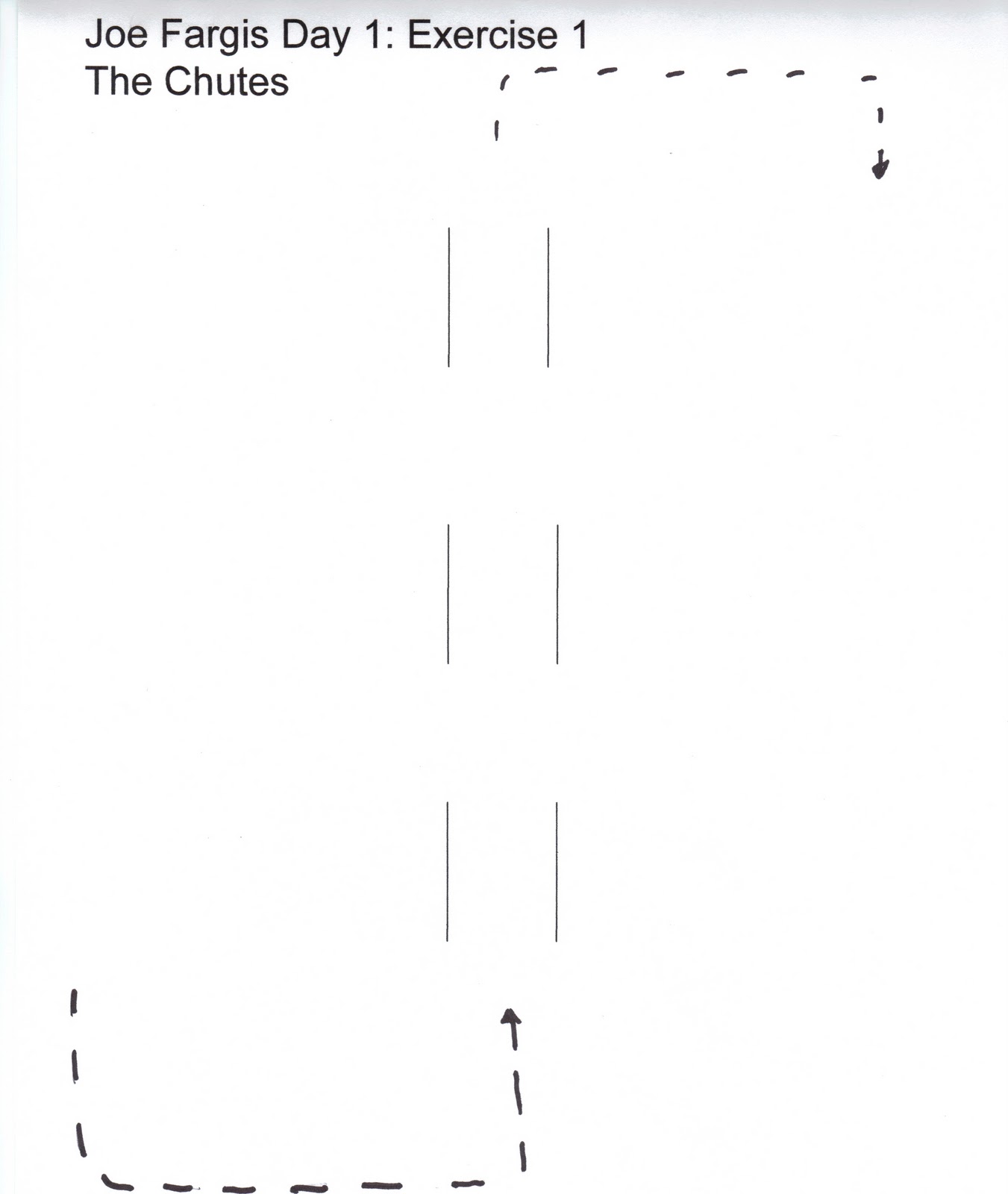
Excercise 1: Day 1 - The Chutes
Public Service Announcement for all clinic attendees: If you are privileged enough to ride in a clinic, any clinic, treat it as though you are riding in front of Queen Elizabeth II on royal parade. Clean every part of your tack, your equipment and your horse’s equipment until it shines. It’s a sign of respect for yourself, your horse, and the individual who teaching you.


If you are auditing a clinic, please be considerate of your fellow auditors by turning off your cell phone and foregoing chatter. If you must say something, whisper. If you need to take a call, leave the auditing area. People have paid to hear the clinician, not you.

This past weekend I had the opportunity to audit sections of a clinic given by Joe Fargis, winner of the individual Olympic Gold medal in show jumping at the 1984 Los Angeles Olympics. The clinic was held at stunning Knightsbridge Farm, a hunter/jumper/equitation facility operated by Mary Babick in Middletown, NJ. Many thanks to Sarah Doehler, owner of First Edition Farm in Whitehouse Station, NJ, and trainer of one of the students in the clinic, for inviting me.

On Saturday I caught the last session, for riders who regularly jumped at 3’6” or higher. Joe asked them to warm the horses up on a loose rein, and by loose, he meant on the buckle. It was chilly, and quite a few of the horses were frisky. Joe told the riders not to interfere or to fight, rather to just let the horses be fresh and get the excess energy out. “Don’t panic when they’re fresh, just be loose. Let them be. It takes two to fight, two to pull. They’re just being horses.”

As everyone warmed up Joe assessed the riders’ positions. Nothing escaped his notice. Some riders were told to sit up without stiffening and “Put your shoulder blades in your back pocket.” He asked them to imagine they were like the African tribeswomen who carried laundry in baskets on their head; the women had to stand upright in order for their load to stay balanced. He also cautioned the riders with quick horses that leaning forward could exacerbate the problem, “If you lean forward the horse rushes to catch up.” One rider had a habit of leaning forward and looking down, and he cautioned her, saying, “Imagine you’re driving – you need to look where you’re going!”

Riders were reminded regularly to raise their ands, to make certain they had a straight line from elbow through the hand to the bit for maximum leverage, elasticity, and sympathetic connection with the horse’s mouth. “Imagine you’re connected to the bit with a rubber band,” he said. The idea was to get the horse to reach out to take the bit from you, not for the rider to pull the horse into a false frame.

Joe asked the riders to drop their stirrups to work on getting their legs long and wrapped around the horse. He then had all the riders come in on a circle around him, nose to tail with a horse’s body length in between, which forced them to work to regulate their horse’s gaits. As if that wasn’t challenging enough, Joe then asked the riders to leg yield in on the circle, and then leg yield out. Many riders had difficulty getting their horses to offer a true leg yield with the legs crossing over. Joe pushed the riders to work harder, and use their leg aids more effectively, stressing that every detail matters when training horses, and “unless you practice it exactly you’ll never it will never be exact.”

The next exercise concentrated on controlling the shoulders. Joe asked the riders to follow each other down the long side and when the first rider was almost to the end of the long side and the last rider had just started down he asked them all to do a small circle. Let’s just say tat the first couple tries did not exactly look like a drill of the Royal Canadian Mounted Police.

Once he was satisfied with the circles, Joe had them all trot down the long side, prepare the horse for the left turn, turn and cross the ring, turn right at the wall and trot up the opposite long side. At each turn Joe would caution the riders “Don’t lose the outside shoulder. Keep the outside rein contact steady, don’t let the outside rein contact break.” Again, at first it wasn’t the RCMP, but definite progress happened once the riders were able to discern the difference between left and right.

The next exercise consisted of 3 chutes of parallel poles lined up on the center line. Initially the riders practiced walking and maintaining straightness through the chutes, then trot to walk to trot transitions, with each transition occurring within the chute. Then the riders were asked to canter in, transition to a trot in the middle chute, and then pick up a canter on the opposite lead. The final part of this exercise was to canter in, do a simple change of lead through the trot in the first chute, canter to the next chute and do a simple change through the trot in that chute, canter to the final chute, do another simple change, and then canter. Easier read than done, right?

Excercise 2: Day 1  Gymnastic
The final exercise of the day was a gymnastic with a tight turn (again, controlling the shoulders) to 2 trot poles set in front of a pile of poles and then two strides to another pile of poles and another two strides to a third pile of poles and then a chute. Some of the riders were so busy concentrating on the poles and the striding that they forgot the initial portion of the exercise and lost control of the shoulders on the turn, resulting in a bit of awkwardness. Some of the horses and riders wanted to rush the poles, and Joe urged the riders “Don’t let the jump be a big event. Sigh. Just sigh and gently ask the horse to gear down, he’ll come back.”

I see where the sighing thing comes from. I hold my breath, which causes tension and transmits to the horse, but really, when a horse is making a serious bid and dragging you to a fence, it can be difficult to sigh. However, if you’ve ever watched the great Ludger Beerbaum ride, you can see him letting out great gusts of air between pursed lips. I’ve often wondered if this is a purposeful relaxation technique, or just something he happens to do.
After a couple trips, Joe raised the pile of poles after the trot poles to a small vertical. Again, those that cut the turn or let the shoulders budge had problems with the trot poles and the vertical, and had a bit of work to do in order to recover for the 2 sets of poles set on the two strides. Joe then set the second set of poles as a second vertical, and the riders went through that. When some had difficulty, Joe told them they needed to worry less about the jump itself and more about control before and after the jump. “You need to recover more quickly and balance the horse up!” He then tested the group’s ability to do exactly that even further by setting the final poles as an oxer.

Even as the riders were negotiating the exercise, Joe was on them to correct flaws in their position as well as their execution. It’s very clear to anyone watching him that function very much follows form in his mind, which, if you watched McLain Ward’s session at the recent George Morris Horsemastership Training Session, you know is a big theme for McLain as well.

Joe ended the session by pressing the easy button for both horse and rider. After the group had finished to full run through, he tested their learning by taking the oxer away, then the second vertical, and then he asked the riders to simply trot over the trot poles and vertical and gently transition the horse to the walk and then a halt while keeping the straightness. You could hear several of the riders and horses sigh in relief as they were able to end on a relaxing and successful note.

It’s amazing when you have the opportunity to listen to the great ones teach. You almost walk in expecting miraculous revelations to spew like gospel from their lips, when really, what they say are variations on the same theme. It may just be how they say it that makes more sense to you. For example, when I rode with Eric Horgan, he encouraged us to think of what we were doing with the horse as a dialogue, not a series of orders. We were to think of ourselves as engaged in daily training, or a series of conversations with our partner (eg. a dialogue).

Again, if you watched the recent George Morris Horsemastership Training Sessions on the USEF Network, you’d have seen Kent Farrington stress the same thing in his session. Kent said over and over again how you needed to work as a partner with your horse, as a team, which is another way of saying you need to have a dialogue. McLain Ward called it being sympathetic. In this clinic, Joe encouraged riders to do things “gently.” He would ask them to “gently” transition to another gait, or “gently” gear down, or ask them to “prepare” their horses for a movement.

I would say that this is another way of making sure your riding is all about the details, with the most important detail being your communication with your partner, the horse.

More to come from Day 2 later…

Saturday, January 7, 2012

Great Day!

This is NOT me jumping Stratego. If it were me,
there would be seatbelts and airvests!
Am in a really great mood and feeling like the luckiest broad on the planet.

I was able to take a lesson on my friend's horse Stratego today, which was wonderful.  (Thank you, Libby!!!) Learned a lot about how to ride him; even jumped him a bit.  This horse has a MONSTER jump.  Seriously, you could have an air hostess and drink service on this boy, you get up so high and stay up there so long.  We only jumped baby stuff in defernce to my confidence issues, but we overcame our difficulties and I'm hopeful I'll get another chance to jump him again soon.

After my lesson, I took the Sainted Mare outside for a hack in the gorgeous weather. It was sixty (6-0!!) degrees today and you can bet your boopie I was taking advantage of it.  Sug liked being outside, as she did a lot of sighing and snorting.

After our hack I took Cookie, my daughter's pony,  for a walk and a graze, and zipped down the highway to spend the afternoon at Knightsbridge Farm auditing the Joe Fargis clinic being held there. More on this later...

Really, it doesn't get much better than that.